Given an integer n, return the number of prime numbers that are strict less than n.
Example 1:
<strong>Input:</strong> n = 10
<strong>Output:</strong> 4
<strong>Explanation:</strong> There are 4 primes less than 10: 2, 3, 5, 7.
Example 2:
<strong>Input:</strong> n = 0
<strong>Output:</strong> 0
Example 3:
<strong>Input:</strong> n = 1
<strong>Output:</strong> 0
Constraints:
0 <= n <= 5 * 10<sup>6</sup>
Naïve Approach (Time Limit Exceeded)
class PrimeValidator:
   def count_below_bound(self, bound: int) -> int:
       total_primes = 0
       for candidate in range(2, bound):
           divisor_limit = int(candidate ** 0.5)
           is_prime_number = True
           for factor in range(2, divisor_limit + 1):
               if candidate % factor == 0:
                   is_prime_number = False
                   break
           if is_prime_number:
               total_primes += 1
       return total_primes
Optimized: Sieve of Eratosthenes
import math

class Solution:
   def count_primes(self, limit: int) -> int:
       if limit < 3:
           return 0

       prime_status = [True] * limit
       prime_status[0] = prime_status[1] = False

       for base in range(2, int(math.sqrt(limit)) + 1):
           if prime_status[base]:
               for multiple in range(base * base, limit, base):
                   prime_status[multiple] = False

       return sum(prime_status)
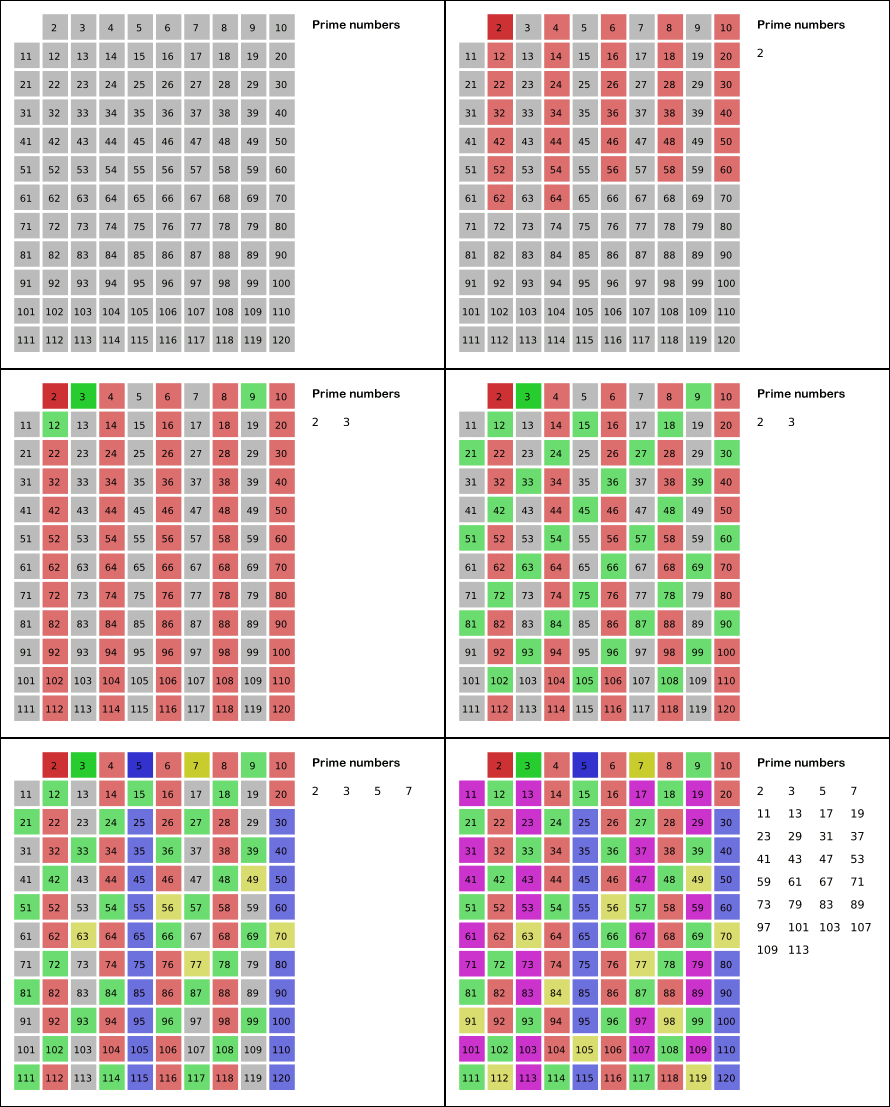
The core improvement comes from the Sieve of Eratosthenes:
To find all primes below a natural number n, you only need to filter out the multiples of every prime that is no greater than √n. What remains are the primes.
Algorithm Overview
- Begin with 2, and mark all multiples of each prime as composite.
- Repeat this process until all numbers up to √n have been processed.
Step-by-Step
- Initialization:
- Create a boolean list
prime_statusof lengthn, initially allTrue.prime_status[i]indicates whetheriis prime. - Set
prime_status[0]andprime_status[1]toFalsesince 0 and 1 are not prime.
- Create a boolean list
- Mark composites:
- Iterate starting from 2. For each unmarked number
base, mark all its multiples (starting frombase * base) as composite. - Starting at
base * baseavoids redundant work because smaller multiples have already been handled by earlier primes.
- Iterate starting from 2. For each unmarked number
- Optimization:
- The loop stops when
base > √n, because any larger prime’s multiples would exceed n or would have already been covered.
- The loop stops when
Why start from base * base?
When processing a prime base, every composite of the form base * k with k < base has already been marked when we processed the smaller factors. For example, when base = 3, the multiples 6 and 9 were already handled by base = 2 and base = 3 respectively. Beginning at base * base skips this duplication.
Why stop at √n?
A composite number n can always be written as a * b. If both a and b were larger than √n, their product would exceed n. Thus, at least one factor must be ≤ √n, so it suffices to eliminate multiples of numbers up to √n.