LeetCode 54: Spiral Matrix
Problem
Given an m x n matrix, return all elements of the matrix in spiral order.
Example 1
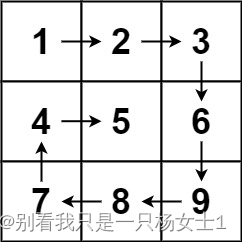
Input: matrix = [[1,2,3],[4,5,6],[7,8,9]] Output: [1,2,3,6,9,8,7,4,5]
Example 2
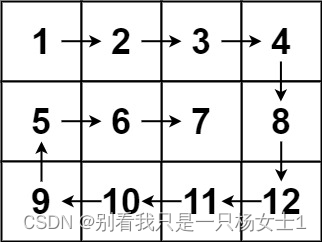
Input: matrix = [[1,2,3,4],[5,6,7,8],[9,10,11,12]] Output: [1,2,3,4,8,12,11,10,9,5,6,7]
Approach
- Traverse from left to right along the top row:
(top, left)to(top, right). - Traverse from top to bottom along the right column:
(top+1, right)to(bottom, right). - If
left < rightandtop < bottom, traverse from right to left along the bottom row:(bottom, right-1)to(bottom, left+1), and from bottom to top along the left column:(bottom, left)to(top+1, left). - After finishing a layer, increment
leftandtop, decrementrightandbottom, and continue until all elements are proecssed.
Solution Code
/**
 * Note: The returned array must be malloced, assume caller calls free().
 */
int* spiralOrder(int** matrix, int matrixSize, int* matrixColSize, int* returnSize) {
    if (matrixSize == 0 || matrixColSize[0] == 0) {
        *returnSize = 0;
        return NULL;
    }
    int total = matrixSize * matrixColSize[0];
    int* result = (int*)malloc(sizeof(int) * total);
    int top = 0, bottom = matrixSize - 1;
    int left = 0, right = matrixColSize[0] - 1;
    int index = 0;
    while (left <= right && top <= bottom) {
        for (int col = left; col <= right; col++) {
            result[index++] = matrix[top][col];
        }
        for (int row = top + 1; row <= bottom; row++) {
            result[index++] = matrix[row][right];
        }
        if (left < right && top < bottom) {
            for (int col = right - 1; col > left; col--) {
                result[index++] = matrix[bottom][col];
            }
            for (int row = bottom; row > top; row--) {
                result[index++] = matrix[row][left];
            }
        }
        left++;
        right--;
        top++;
        bottom--;
    }
    *returnSize = index;
    return result;
}
LeetCode 445: Add Two Numbers II
Problem
You are given two non-empty linked lists representing two non-negative integers. The most significant digit comes first, and each node contains a single digit. Add the two numbers and return the sum as a linked list.
You may assume the two numbers do not contain any leading zero, except the number 0 itself.
Example 1
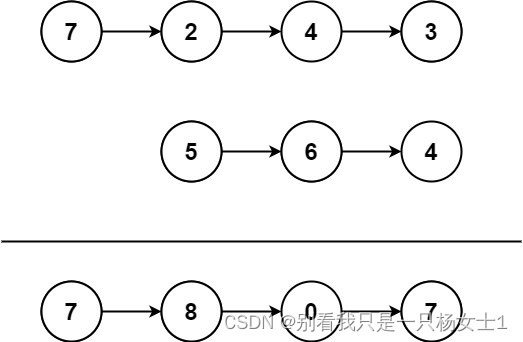
Input: l1 = [7,2,4,3], l2 = [5,6,4] Output: [7,8,0,7]
Example 2
Input: l1 = [2,4,3], l2 = [5,6,4] Output: [8,0,7]
Example 3
Input: l1 = [0], l2 = [0] Output: [0]
Approach
- Reverse both linked lists
l1andl2to simulate addition from least significant digit. - Create a dummy head node and use tail insertion to store the sum of corresponding digits, handling carry.
- After processing all digits, reverse the resulting list to restore original order.
Solution Code
/**
 * Definition for singly-linked list.
 * struct ListNode {
 *     int val;
 *     struct ListNode *next;
 * };
 */
struct ListNode* reverse(struct ListNode* head) {
    struct ListNode* prev = NULL;
    struct ListNode* curr = head;
    while (curr) {
        struct ListNode* nextTemp = curr->next;
        curr->next = prev;
        prev = curr;
        curr = nextTemp;
    }
    return prev;
}

struct ListNode* addTwoNumbers(struct ListNode* l1, struct ListNode* l2) {
    struct ListNode* rev1 = reverse(l1);
    struct ListNode* rev2 = reverse(l2);

    struct ListNode dummy;
    dummy.next = NULL;
    struct ListNode* tail = &dummy;

    int carry = 0;
    while (rev1 || rev2 || carry) {
        int x = rev1 ? rev1->val : 0;
        int y = rev2 ? rev2->val : 0;
        int sum = x + y + carry;
        carry = sum / 10;

        tail->next = (struct ListNode*)malloc(sizeof(struct ListNode));
        tail->next->val = sum % 10;
        tail->next->next = NULL;
        tail = tail->next;

        if (rev1) rev1 = rev1->next;
        if (rev2) rev2 = rev2->next;
    }

    struct ListNode* result = reverse(dummy.next);
    return result;
}