Neural network vectorization refers to converting input data into vector form to facilitate processing by neural networks. The benefits include:
- Improved computational efficiency: Vectorized inputs enable praallel computation, accelerating training and inference.
- Reduced storage: Compresssing raw data into smaller vectors reduces memory usage.
- Simplified data processing: Vectorization transforms complex inputs into a uniform format, making pattern recognition easier.
- Support for diverse input types: Different data types (images, text, audio) can be converted into vectors, allowing neural networks to handle various inputs.
- Enhanced expressiveness: Vectorization extracts features, improving model performance and accuracy.
Let's dive in to the vectorized implementation of neural networks.
Matrix Multiplication in Numpy
Define a matrix A:
A = np.array([[1, -1, 0.1],
              [2, -2, 0.2]])
Its transpose AT:
AT = A.T
Define a matrix W:
W = np.array([[3, 5, 7, 9],
              [4, 6, 8, 0]])
Compute Z = AT · W:
Z = np.matmul(AT, W)
Or equivalently:
Z = AT @ W
Vectorized Forward Propagation
Using the coffee roasting example (200 degrees, 17 minutes):
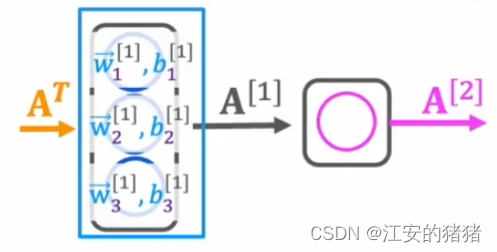
Initialize variables:
AT = np.array([[200, 17]])
W = np.array([[1, -3, 5],
              [-2, 4, 6]])
b = np.array([[-1, 1, 2]])
Define a dense layer:
def dense(AT, W, b, g):
    z = np.matmul(AT, W) + b
    a_out = g(z)
    return a_out  # a_out == [[1, 0, 1]]
This implementation demonstrates how vectorization streamlines neural network computations.