1. Introduction
- Snowflake is an open-source distributed ID generation algorithm from Twitter.
- Core idea: Use a 64-bit long integer as a globally unique ID.
2. Structure

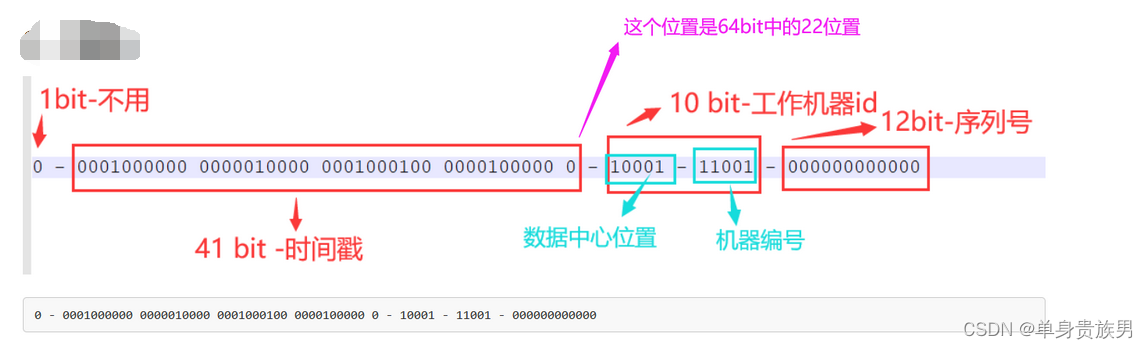
0 - 0001000000 0000010000 0001000100 0000100000 0 - 10001 - 11001 - 000000000000
2.1 Part 1: 1 bit
- 1 bit, unused.
- Reason: If the first bit were 1, the number would be negative. Since all generated IDs are positive, the first bit is always 0.
2.2 Part 2: 41 bits
- 41 bits representing a timestamp.
- Unit: milliseconds.
- Can be used for 69 years.
- Reason: 2^41 - 1 milliseconds ≈ 69 years.
2.3 Part 3: 10 bits
- Records the machine ID. Allows deployment on up to 2^10 = 1024 machines.
- Within these 10 bits, 5 bits represent the data center ID, and 5 bits represent the machine ID. This allows up to 2^5 = 32 data centers, each with up to 2^5 = 32 machines. Adjust according to your company's actual situation.
2.3.1 Subpart 1: 5 bits (data center ID)
- 5 bits for data center ID, e.g., 10001.
2.3.2 Subpart 2: 5 bits (machine ID)
- 5 bits for machine ID, e.g., 11001.
2.4 Part 4: 12 bits
- 12 bits for sequence number.
- Represents the serial number of IDs generated in the same millisecond on the same machine.
- Maximum value: 2^12 = 4096, i.e., 0 to 4095.
3. Summary
3.1 Process of Generating a Unique ID
Suppose a service needs a globally unique ID. It sends a request to the system running the Snowflake algorithm, which generates the ID.
This system knows its own data center and machine IDs, e.g., data center ID = 17, machine ID = 25.
Upon receiving the request, the Snowflake system uses bitwise operations to generate a 64-bit long ID:
- 1 bit: Set to 0.
- 41 bits: Use the current timestamp (in milliseconds) to generate 41 bits.
- 5 bits: Data center ID = 17, generate 5 bits.
- 5 bits: Machine ID = 25, generate 5 bits.
- 12 bits: Determine the sequence number for this request within the current millisecond, then increment the counter.
The result is a 64-bit ID that is guaranteed to be unique for a given machine within a given millisecond. If multiple IDs are generated in the same millisecond, the last 12 bits differentiate them.
3.2 Conclusion
By setting different flags in different parts of a 64-bit number, each ID is distinguished.
4. Code Example
package com.example.snowflake.demo1;

public class SnowFlake {

    // Start timestamp: 2016-11-26 21:21:05
    private final static long START_STAMP = 1480166465631L;

    // Number of bits for each part
    private final static long SEQUENCE_BIT = 12; // Sequence number bits
    private final static long MACHINE_BIT = 5;   // Machine ID bits
    private final static long DATA_CENTER_BIT = 5; // Data center ID bits

    // Maximum values for each part
    private final static long MAX_DATA_CENTER_NUM = -1L ^ (-1L << DATA_CENTER_BIT); // 31
    private final static long MAX_MACHINE_NUM = -1L ^ (-1L << MACHINE_BIT); // 31
    private final static long MAX_SEQUENCE = -1L ^ (-1L << SEQUENCE_BIT); // 4095

    // Left shifts for each part
    private final static long MACHINE_LEFT = SEQUENCE_BIT;
    private final static long DATA_CENTER_LEFT = SEQUENCE_BIT + MACHINE_BIT;
    private final static long TIMESTAMP_LEFT = DATA_CENTER_LEFT + DATA_CENTER_BIT;

    private long dataCenterId;
    private long machineId;
    private long sequence = 0L;
    private long lastStamp = -1L;

    public SnowFlake(long dataCenterId, long machineId) {
        if (dataCenterId > MAX_DATA_CENTER_NUM || dataCenterId < 0) {
            throw new IllegalArgumentException("Data center ID exceeds maximum or is negative");
        }
        if (machineId > MAX_MACHINE_NUM || machineId < 0) {
            throw new IllegalArgumentException("Machine ID exceeds maximum or is negative");
        }
        this.dataCenterId = dataCenterId;
        this.machineId = machineId;
    }

    public synchronized long nextId() {
        long currStamp = getNewStamp();
        if (currStamp < lastStamp) {
            throw new RuntimeException("Clock moved backwards, refusing to generate ID");
        }

        if (currStamp == lastStamp) {
            sequence = (sequence + 1) & MAX_SEQUENCE;
            if (sequence == 0L) {
                currStamp = getNextMill();
            }
        } else {
            sequence = 0L;
        }

        lastStamp = currStamp;

        System.out.println("Timestamp: " + (currStamp - START_STAMP));
        System.out.println("Timestamp left shift: " + TIMESTAMP_LEFT);
        System.out.println("Data center ID: " + dataCenterId);
        System.out.println("Data center ID left shift: " + DATA_CENTER_LEFT);
        System.out.println("Machine ID: " + machineId);
        System.out.println("Machine ID left shift: " + MACHINE_LEFT);
        System.out.println("Sequence: " + sequence);

        long id = (currStamp - START_STAMP) << TIMESTAMP_LEFT
                | dataCenterId << DATA_CENTER_LEFT
                | machineId << MACHINE_LEFT
                | sequence;

        System.out.println("ID binary: " + Long.toBinaryString(id));
        return id;
    }

    private long getNextMill() {
        long mill = getNewStamp();
        while (mill <= lastStamp) {
            mill = getNewStamp();
        }
        return mill;
    }

    private long getNewStamp() {
        return System.currentTimeMillis();
    }

    public static void main(String[] args) {
        SnowFlake snowFlake = new SnowFlake(3L, 10L);
        System.out.println("Next ID: " + snowFlake.nextId());
    }
}
5. Logic of sequence = (sequence + 1) & MAX_SEQUENCE
5.1 Auto-increment within the same millisecond
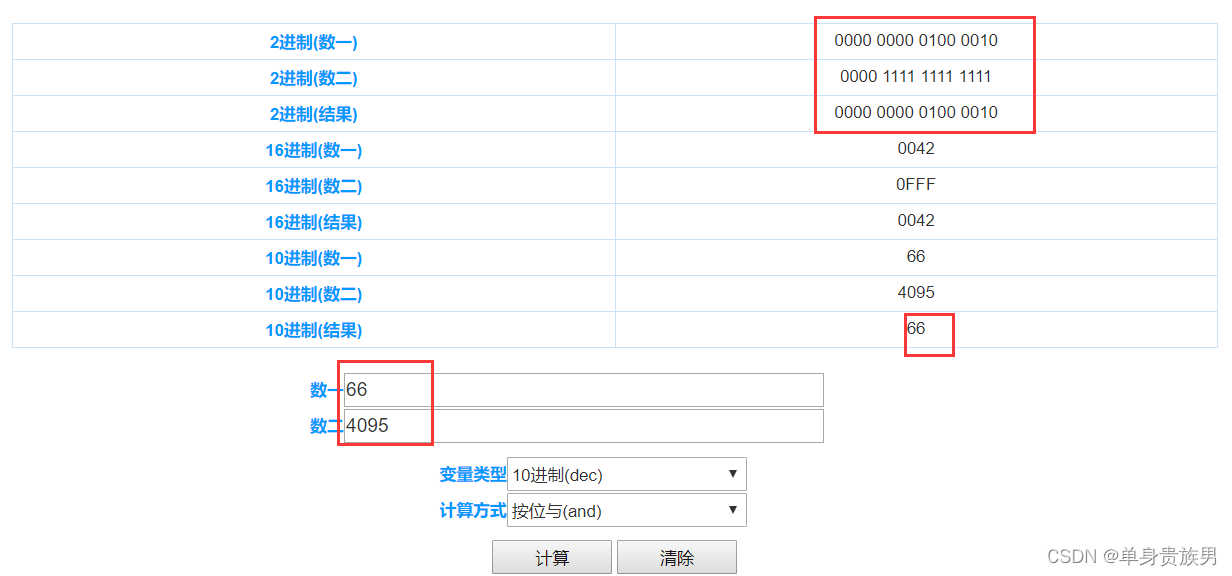
- Formula:
1&1=1, 1&0=0, 0&1=0, 0&0=0 MAX_SEQUENCEis 2^12 - 1 = 4095, binary1111 1111 1111.- The operation
x & MAX_SEQUENCEpreserves the lower 12 bits ofx.
5.2 Ensuring sequence stays within range
- Bits beyond the 12th from the right are zeroed out, so the value never exceeds
MAX_SEQUENCE.
Test Tool
6. Principal of (currStamp - START_STAMP) << TIMESTAMP_LEFT | dataCenterId << DATA_CENTER_LEFT | machineId << MACHINE_LEFT | sequence
6.1 Why shift currStamp - START_STAMP by 22 bits?
TIMESTAMP_LEFT = 22
6.2 Example
t = currStamp - START_STAMP, max 2^41 - 1.- Suppose
t = 1000(binary 41 bits:0 0000 0000 0000 0000 0000 0000 0000 0011 1110 1000) dataCenterId = 3(binary 5 bits:0 0011)machineId = 10(binary 5 bits:0 1010)sequence = 0(binary 12 bits:0000 0000 0000)
Combined binary:
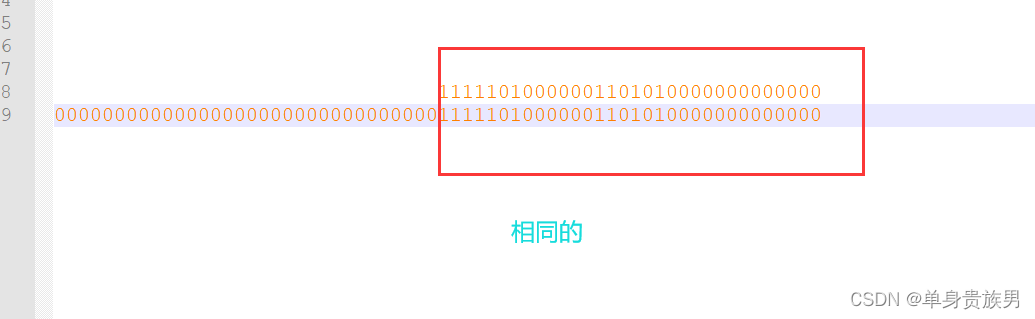
0000000000000000000000000000000011111010000001101010000000000000
Debug output:
Timestamp: 1000
Timestamp left shift: 22
Data center ID: 3
Data center ID left shift: 17
Machine ID: 10
Machine ID left shift: 12
Sequence: 0
ID binary: 11111010000001101010000000000000
Next ID: 4194738176
7. Pros and Cons
7.1 Advantages
- IDs are sorted by time, no collisions across distributed systems (due to data center + machine ID).
- Milliseconds are in high bits, sequence in low bits, so IDs are roughly increasing.
- High throughput: theoretically ≈ 409.6w QPS (1000 * 2^12).
- High availability: generation does not depend on a database; it's done entirely in memory.
- Flexible: bit allocation can be adjusted based on business needs.
7.2 Disadvantages
- Strong dependency on machine clock; if the clock rolls back, duplicate IDs may be generated or service may become unavailable.
- Meituan has made improvements: Leaf
8. Distributed Deployment
8.1 Scenario 1
Application A is deployed in containers with 10 pods. A scheduled task inserts 1000 records per second into table T1. All 10 pods running simultaneously may cause primary key conflicts.
Solution: Use the 10-bit part (Part 3) to differentiate pods by asssigning different machine IDs.
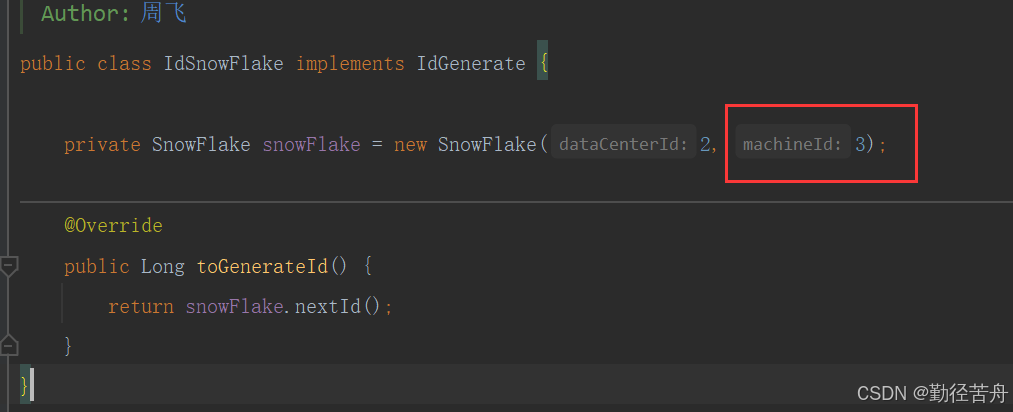
The machine ID can be derived by converting the pod IP to a number and taking modulo 32 (since 2^5 = 32 possible machine IDs).