With the advent of the big data era, extracting meaningful structures and patterns from massive, high-dimensional, and redundant data has become a critical challenge in machine learning and signal processing. Sparse coding (SC) is an effective unsupervised learning method that reveals the intrinsic structure and latent regularities of data by seeking a sparse representation. It provides a powerful tool for dimensionality reduction, feature learning, image processing, and pattern recognition. This article presents a comprehensive exploration of sparse coding, covering its theoretical foundations, implementation details, practical applications, and future directions.
Theoretical Foundations
The theoretical underpinnings of sparse coding come primarily from sparse signal recovery theory, most notably the Restricted Isometry Property (RIP) from compressed sensing and the Donoho-Tanner phase transition theorem. The RIP theorem guarantees that under certain conditions, a sparse signal can be accurately recovered from far fewer observations than its dimension. The Donoho-Tanner theorem characterizes the relationship between the success probability of signal recovery, sparsity level, and measurement noise. These results provide a solid mathematical guarantee for the effectiveness and stability of sparse coding.
Algorithmic Principle
The core idea of sparse coding is to represent input data as a sparse linear combination of atoms from an overcomplete dictionary. Formally, given a set of input data  , the goal is to learn a dictionary D and a corresponding sparse coefficient matrix A such that:

Here the dictionary  has K atoms (basis vectors) with K ≫ D, forming an overcomplete set, and each column
  of the coefficient matrix
  is the sparse representation of the corresponding input vector
  , satisfying
  . The learning process typically alternates between two steps:
- Fix the dictionary, update the coefficients: Given the current dictionary D, for each input vector , solve the optimization problem
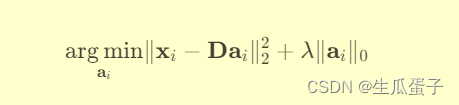
to obtain its sparse coefficient vector, where  denotes the ℓ₀ pseudo‑norm (count of non-zero entries) and λ is a regularisation parameter controlling sparsity.
 - Fix the coefficients, update the dictionary: Keeping the coefficient matrix A fixed, update the dictionary D by minimising the reconstruction error:
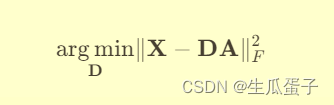
where is the Frobenius norm.
These two steps alternate until convergence or a preset number of iterations is reached.
Implementation in Python
Below is a rewritten example using scikit-learn’s SparseCoder, with modified variable names and a streamlined structure while preserving the OMP‑based encoding logic.
import numpy as np
from sklearn.decomposition import SparseCoder

# Generate synthetic data
num_points = 10
feature_dim = 20
dictionary_atoms = 9

data = np.random.rand(num_points, feature_dim)

# Initialise a random overcomplete dictionary
atom_matrix = np.random.randn(feature_dim, dictionary_atoms)

# Configure the sparse encoder with orthogonal matching pursuit
model = SparseCoder(dictionary=atom_matrix,
                    transform_algorithm='omp',
                    transform_n_nonzero_coefs=5)

# Encode the input data
codes = model.transform(data)

print("Original data (first two samples):")
print(data[:2])
print("\nLearned sparse representations (first two samples):")
print(codes[:2])
In practical scenarios, the dictionary is often learned from the data itself (e.g., via K‑SVD) rather than being randomly initialised.
Strengths and Limitations
Strengths
- Sparse representation: Reveals the intrinsic structure and essential features of the data.
- Feature learning: The adaptively learned dictionary serves as an effective set of basis features for downstream tasks such as classification.
- Noise robustness: Sparse coding is inherently robust to noise by ignoring irrelevant or noisy components.
- Compression efficiency: Data can be encoded at a low bit rate thanks to sparse representations.
Limitations
- Computational complexity: The iterative optimisation process can be slow, especially for large-scale, high-dimensional data.
- Sparsity level selection: The regularisation parameter λ significantly influences the results and requires careful tuning (e.g., via cross-validation).
- Overfitting in dictionary learning: The learning process may overfit; regularisation or early stopping is often necessary.
- Non‑convex optimisation: The ℓ₀ norm problem is non‑convex and may converge to local optima.
Application Domains
- Image processing: Image denoising, super‑resolution, and classification by learning sparse representations of image patches.
- Biomedical signal analysis: Feature extraction and disease diagnosis for EEG, ECG, and other physiological signals, uncovering underlying patterns.
- Natural language processing: Word embedding learning and document topic modelling, where sparse lexical representations enhance generalisation and interpretability.
Comparison with Related Methods
- Principal Component Analysis (PCA): PCA maximises variance through linear projection; sparse coding explicitly seeks sparsity and feature selection, not just low‑rank approximation.
- Autoencoders: Autoencoders learn low‑dimensional representations via an encoder‑decoder architecture, often with dense hidden layers; sparse coding imposes explicit sparsity constraints through optimisation.
- K‑means clustering: K‑means partitions data into clusters, while sparse coding decomposes data into a weighted sum of dictionary atoms, focusing on a parts‑based decomposition.
Future Outlook
- Accelerated algorithms: Developing more efficient solvers using GPU parallelism and distributed computing to handle massive datasets.
- Advanced regularisation: Incorporating structural and group sparsity to improve generalisation and interpretability.
- Theoretical advances: Deeper investigation into dictionary convergence and the uniqueness of sparse representations to provide stronger theoretical support for algorithm design.